
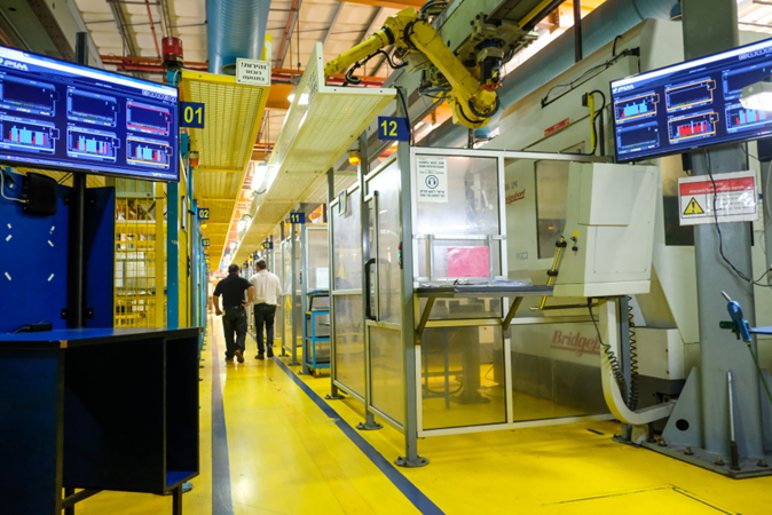
Many late orders are created in the plan, not on the floor. Schedules are loaded with nominal capacity: full shift hours, one standard cycle time per part, interchangeable machines and a standard changeover. A small IoT device on the machine's electrical signals measures the productive hours each machine really gives, the cycle time of each part on each machine and the real changeover. Loading the board with those numbers shows which machine should run which order and which dates are at risk while there is still time to act.
The order that was late before the shift started
Many late orders are not created on the floor; they are created in the plan. In the component plants we connect, the planner usually loads each machine the same way: the hours in the shift, minus the breaks, divided by the standard cycle time of the part. The arithmetic is correct. The inputs are not. The shift does not give all of its hours, the part does not run at its standard cycle on that machine, and the changeover between two orders takes longer than the routing says. The schedule is full on paper and overloaded in reality, and the order at the end of the sequence is late before the first part is made.
The floor then gets the blame for a delay it never had a chance to avoid, and answers with overtime, split jobs and urgent orders moved ahead of others. In our experience this is the daily routine of a plant that plans with nominal capacity instead of the capacity its machines really have.
Four assumptions hiding in every schedule
When we sit with a planner and look at how the load per machine was calculated, the same four assumptions appear.
- Every hour of the shift is a productive hour. The calendar knows the breaks and the planned maintenance. It does not know the short stops, the waiting for material or the first hour after a start-up, and those repeat every shift.
- The standard cycle time is the cycle time. The standard was set at quoting or at the first run. A year later, with a different tool condition and different habits, the same part runs at a different rate.
- The machines in a group are interchangeable. The routing says the part can run on any of four presses. The supervisor knows it runs well on one and badly on another, and that knowledge is not in the planner’s file.
- A changeover takes the standard time. The time between the last good part of one order and the first approved part of the next is rarely measured, so the plan uses a number nobody has checked.
None of these is the planner’s mistake; they are the only numbers available. A schedule can only be as honest as the capacity figures it is built on.
What the machine already knows about its own capacity
The missing numbers do not have to be estimated; the machine produces them every shift. On every machine the electrical signals are the same: running, stopped, cycle, count. A small IoT device on those signals, installed by the plant’s own electrician in under an hour, with no PLC connection and no change to any program, is enough to read them. What differs is the machine, the process, the product and the operating environment, even between two presses standing side by side, and the Universal Adapter in the cloud interprets the same signals with the context of that specific machine.
After a few weeks of running, the plant has three things it did not have before: the productive hours each machine really gives per shift, the measured cycle time of each part on each machine, and the real duration of each changeover. These are the inputs of a schedule. In the Scheduling & Dispatching product the same signals also report the progress of every order on the board, so the plan and the capacity behind it come from one source.
Which machine should run this order
The question a planner answers many times a day is where to put an order. With one standard cycle time per part, every machine in the group looks the same and the choice goes to whichever is free. With a measured cycle per machine, the choice has a cost that can be read. The plants we connect usually find that the same part runs at visibly different rates on machines the routing treats as equal, and that the difference is steady enough to plan with.
That changes three everyday decisions. The order goes first to the machine where it runs best, and when that machine is busy the planner knows how many extra hours the alternative will take. A rush order placed on the board shows what it pushes back, because the load is counted in the hours each machine actually delivers. And the supervisor’s knowledge of which part likes which machine stops living in one person’s head; it is on the report, per part and per machine.
It also changes the conversation about the slower machine. A part that takes longer on one press than on its neighbour is no longer a reason to avoid that press quietly; it is a question for process engineering and maintenance, with a number attached.
What changes in the planning office
The first effect is uncomfortable. When the board is loaded with measured capacity, the week that looked full turns out to be over-full, and some promised delivery dates cannot be met as planned. In our experience it is better to see that on Monday morning than on Thursday night: the planner can re-sequence, sales can talk to the customer early, and overtime becomes a decision instead of a reflex.
The second effect is that the warnings on the board start to mean something. On a plan built from nominal numbers, a delayed or overlapping order is one of many and people learn to ignore the colour. On a plan built from measured numbers a flag is an exception, and the supervisor walks to that machine. For a component manufacturer supplying an automotive OEM, the delivery commitment then rests on what the machines have shown they can do.
What we learned
A schedule is a promise made with capacity numbers, and most plants make it with numbers that were set once and never measured. Productive hours per shift, cycle time per part and per machine, and the real length of a changeover are all available from the machine’s own signals. Planning with them does not make the machines faster; it makes the plan one the floor can keep.
Start with one machine group and the five parts that run on it most often. Put the measured cycle times per machine next to the standard, load next week with the measured ones, correct the standards in the planning file as you go, and see how many of the late orders were already late in the plan. If you would like to do that with your own order list, bring it to a demo and we will put it on the board with you.
Questions people ask
Why are orders late when the production schedule looked feasible?
Because most schedules are loaded with nominal capacity: the full hours of the shift, one standard cycle time per part and a standard changeover. The shift gives fewer productive hours than the calendar shows, the part runs at a different rate on each machine and changeovers take longer than the routing says, so the plan is overloaded before the shift starts.
When several machines can run the same part, how do you decide which one gets the order?
Compare the measured cycle time of that part on each machine that has run it. The order goes first to the machine where it really runs best, and when that machine is busy the planner knows how many extra hours the alternative will take, so the choice is a decision with a known cost rather than whichever machine is free.
How can a plant measure real capacity per machine without an IT project?
A small IoT device on the machine's electrical signals reports running, stopped, cycle and count. An electrician installs it in under an hour, with no PLC connection and no change to any program, and the plant's own people can do it. The Universal Adapter in the cloud interprets those signals with the context of each specific machine and turns them into productive hours per shift and cycle time per part and per machine.